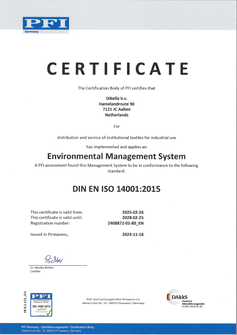
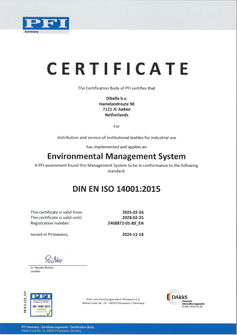
There are now many different seals and certifications in different business areas. We at Dibella are certified in the areas relevant to us and our customers. Often our own demands with respect to production conditions and the products are significantly higher than the minimum requirements.
Our company is certified according to ISO 9001 and ISO 14001 as we want to be sure of giving our customers the best possible quality in tandem with the smallest possible environmental impact.
2
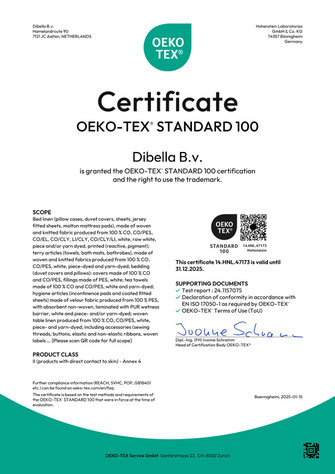
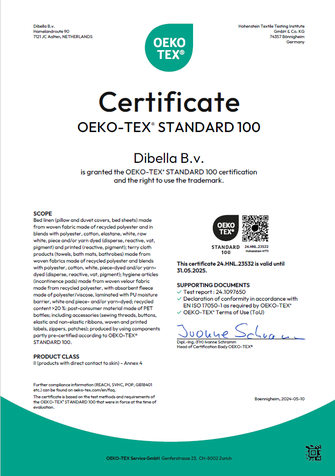
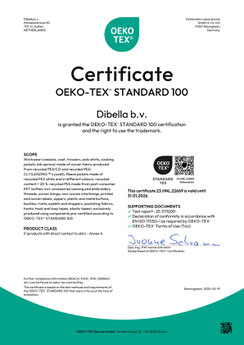
Parts of our range are certified according to
Standard 100 by OEKO-TEX® (Left: Article without rec. PES or mid: Article with a rec. PES content of at least 20 % and right: Workwear-article with a rec. PES content of at least 20 %)
For the product-specific assignment, please refer to the product descriptions.
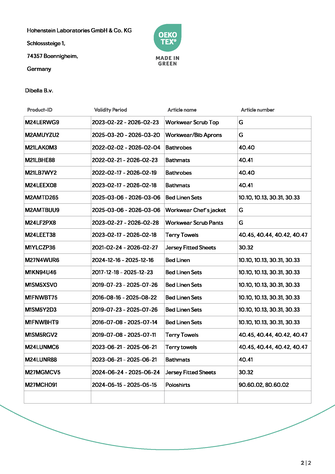
Parts of our assortment are certified according to
MADE IN GREEN by OEKO-TEX®. For the product-specific assignment, please refer to the product descriptions.
3

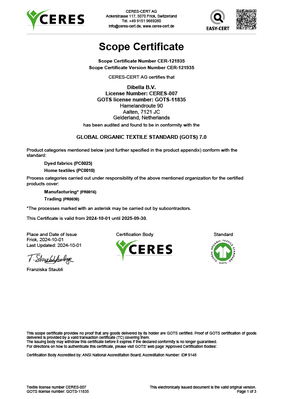
Parts of our assortment are certified according to Global Organic Textile Standard (GOTS) and Organic Content Standard (OCS). For the product-specific assignment, please refer to the product descriptions.

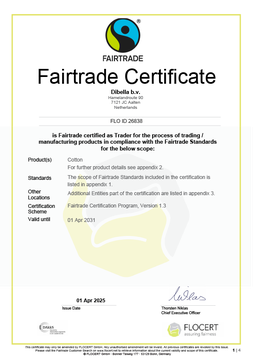
Parts of our assortment are Fairtrade certified. For the product-specific assignment, please refer to the product descriptions.
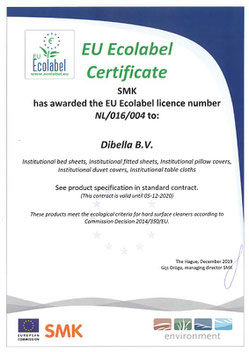
Parts of our assortment are EU-Ecolabel certified. For the product-specific assignment, please refer to the product descriptions.
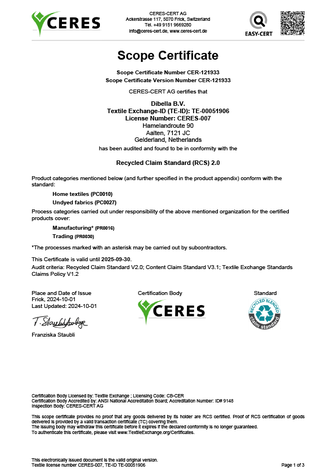
With our contract textiles made from recycled fibres, you should be able to rely on the fact that what‘s inside is what‘s claimed. That‘s why we are certified according to the Recycle Claim Standard (RCS) and Global Recycle Standard (GRS).

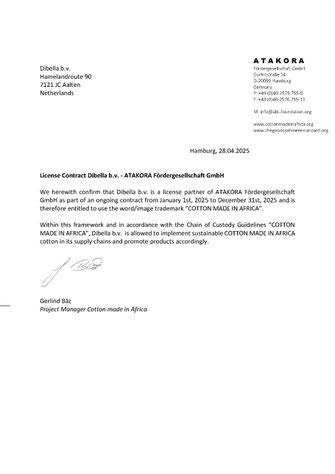
Dibella is proud of its partnership with the Cotton made in Africa (CmiA) initiative, an internationally recognised internationally recognised standard for sustainable cotton grown by small African farmers. grown by African smallholders. CmiA-verified cotton has a significantly lower impact on the environment on the environment than conventional cotton and supports village communities in Africa.
The label is the result of an initiative that helps people to help themselves: Cotton made in Africa supports small farmers in sub-Saharan Africa in the sustainable cultivation of genetically unmodified cotton and is committed to improving working conditions in ginning factories. A licence fee, which is paid by the buyers, provides the farmers with training and access to inputs, thanks to which the use of pesticides is reduced and the quality and yields of their fields increase. Cotton made in Africa pursues a pragmatic approach with two different models. The Hard Identity Preserved System only allows the use of CmiA-licensed cotton with a minimum content of 50 per cent; the processing chain is fully traceable. The Mass Balance System, which Dibella has opted for, allows the use of CmiA fibres “in the area”. The spinning mill buys the sustainable cotton, but has a free hand in processing it. A yarn therefore does not necessarily contain the fibres. However, the quantity of CmiA cotton purchased by the spinning mill must be balanced with the volume of yarn labelled as CmiA.

Related posts

Ganzheitlich gelebte Nachhaltigkeit – entlang der gesamten Wertschöpfungskette
Wir bei Dibella leben einen Holistischen Ansatz und sehen darin unsere individuelle Definition von N …

Unsere nachhaltige Unternehmenskultur
Unsere Philosophie Wir schaffen eine auf definierten Normen und Werten basierte Corporate Identity. Wi …


Ayden Dibbert
Rerum qui eum ut ea facilis recusandae voluptatem minus. Ut sint omnis sunt in doloremque. Nostrum reprehenderit ut earum voluptatem.
Placeat quasi deserunt quia porro et. Eos laudantium quis porro. Exercitationem eveniet vel optio repellat non.
Nisi harum possimus minus facere magnam et dolores sit. Quisquam optio sit et ratione ut voluptatem eaque. Sint earum ut iusto sit voluptas nulla porro.
Nemo modi et facere possimus earum ullam. Voluptates dicta similique quam ex. Facilis deleniti qui tempore.